Sunday, March 29, 2009

Just Another Dawn

Diamond Head: Another Dawn


“Yesterday is but a dream, tomorrow but a vision. But today well lived makes every yesterday a dream of happiness, and every tomorrow a vision of hope. Look well, therefore, to this day. Such is the salutation to the dawn.”
Sanskrit Proverb


Honolulu Fire Department (HFD) Note the surfboard for rescues!

"The pillar of the world is hope.

African Proverb


Treasure the love you have received above all. It will survive long after your gold and good health have vanished.
Og Mandino

This morning, walking on the beach, I set up for my 7,000th shot of diamond Head. "How many pictures of her do I need?" I wondered. But immediately I realized how every season, time of day, and quality of light paints even the most familiar things in infinite and wondrous permutations.

I already have enough pictures of Diamond Head? One might as well say: "I already have a picture of my mother. Why would I want to take another?"

A L O H A! Cloudia


Saturday, March 28, 2009

Neighbor Island Nene

Click on photos to enlarge! Far away from Honolulu. Rural Big Island

“We artists! We moon-struck and God-struck ones! We death-silent, untiring wanderers on heights which we do not see as heights, but as our plains, as our places of safety!”
Friedrich Nietzsche
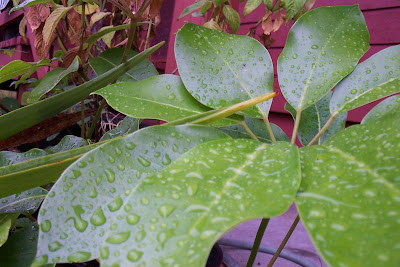


A world of worlds on a green leaf


A wanderer is man from his birth. / He was born in a ship / On the breast of the river of Time.”
Matthew Arnold


The gentle Nene Goose mates for life

“The family is one of nature's masterpieces.”
George Santayana


The winds of the world can blow you off course, especially if you soar far beyond your local skies.


To see your fledgling nest from the top of the highest tree reveals other, undreamed, unexpected vistas of possibility.


At first there is only excitement. Excitement and (to be honest) fear. But the excitement, or the wanderlust, or disgust with your surroundings, goads you higher. The sun is intoxicating, the winds of early Spring beguile like new playmates.


Discomfort is part of the game. Unaccustomed food and voices feed your days. But each moment un-moored bursts with presence. Even boredom is romantic as you explore the streets of a new town before it's morning begins.


You land beside still waters. Children, lovers, madmen, and the aged share a few moments and their crusts of bread with you in the long afternoon light. You sleep with your dreaming head buried in oil slicked feathers, and wake each day to the first day of life in the Garden. But something clicks, the temperature, or temper tantrum of a fellow wanderer. And the sky, always the sky, renews its imprecations as you fly to embrace new winds. Forward always forward. Calling, always calling.


Sometimes answered.


At last, a most heroic flight. With fleets of feathered navigators - far far from accustomed climes, at the end's reach of endurance, above an endless water sky.


First a feeling, then a smell, a change in the vast empyrean. Till low clouds sing the joy: Land! A verdant mountain rises from that endless sea of purgatory. Land! You remember. You once had feet and still wings beside a rock instead of unconstant clouds. Remember?


It wasn't just a dream!


Water and water bugs. Ferns and bracken. No fox, no snake, no lightning. And maybe just because you're finally tired, after crossing the greatest crossing of them all, nudged by upper level jets and the lack of landing for mile upon night, and day upon mile. . . at last you stretch your neck content. Your tail end waggles in satisfaction as you feed. We few are the far fliers. We are the very best!


And after many ages pass, you forget that any other place, any other life ever existed. You are a distinct species: The Nene Goose, State Bird of Hawaii.


We now understand that this emblem of Hawaii, genetically distinct from any other bird, was once an immigrant, a malihini.


It was once a Canada Goose. A visitor off course who stayed, who changed.


Like me.


A L O H A! Cloudia


Friday, March 27, 2009

Aloha Friday!!

Click on photos to enlarge!

Remember when I was little, and you took me to the beach?


"I never think of the future. It comes soon enough." Albert Einstein


Distant Diamond Head


"Anything done out of fear, is a prayer to the devil."

Anonymous


Yes, these men are working half-submerged!


"Are you still colonizing life, or have you gone 'native' yet?"

Anonymous


Before there were casual Fridays, there was "Aloha Friday" here in Hawaii.


The world famous "Aloha Shirt" was initially developed in Honolulu during the Thirties. First, colorful Japanese yukata fabrics were used. Then tropical prints were imported from Tahiti and Samoa. Traditional Hawaiian tapa cloth patterns, and Javanese batiks became popular too.


Ellery Chun, a local alumnus of Mr. Obama's school, Punahou and of Yale University (1931) changed the name of his family's King Street dry goods store from Chun Kam Chow's to King-Smith Clothiers. He arguably developed the concept there, and many consider him to be the father of the aloha shirt. Other local companies such as Gump's Department Store, and Watamull's East India Store, soon commissioned Hawaii artists like Elsie Das to create floral textiles emblazoned with local foliage, surfers and hula dancers. Mr. Chun's sister, Ethel, hand painted her own motifs that were then reproduced on cotton or silk in Japan. Today those vintage "silkies" are worth quite a lot of money!


Other classic-era Aloha Shirts were marketed by Branfleet, Kamehameha, and Royal Hawaiian. But only Mr. Chun had the foresight to trademark the term "Aloha Wear."


In 1947 the City of Honolulu began encouraging locals to wear Hawaiian shirts to work during the Summer months. Soon enough, Fridays year round became "Aloha Friday"s. Ultimately the shirts became ubiquitous, no matter the day of the week. Today in Honolulu's downtown business district few of the men one see's on the streets are wearing suits and ties. The only major exceptions seem to be attorneys and court workers who, nonetheless manage to look "local" in some indefinable way. It's easy to spot a "foreign" businessman in town for a meeting. The conservative grey suit is a dead giveaway!


Of course, the subdued patterns favored by local businessmen for office wear are a far cry from the loud shirts that a visitor to the islands might buy. Companies like Manuheali`i, Tori Richard, and Reyn Spooner are major producers of the finer sort of Aloha Shirt. Couples walking the sidewalk in matching Aloha Wear might as well wear a sign reading: "Tourist." But that's OK. Our whole economy is based on the visitor industry! So wear what you like, and have a wonderful day.


As the song says: "It's Aloha Friday - no work till Monday." See you at Da Beach! Mahalos to Alan Brennert, author of Honolulu, for his research on the topic.
A L O H A! Cloudia

Thursday, March 26, 2009

Choose Your Path

Click on photos to enlarge! Empty beach - Full sky


"The opposite of prosperity is not extinction."


Ian Parker


Undisturbed Morning, Waikiki


"Look deep, deep into nature, and then you will understand everything better."
Albert Einstein


Blooming Aloe & Fuel


“When all's said and done, all roads lead to the same end. So it's not so much which road you take, as how you take it.”
Charles de Lint


While learning to ride a motorcycle, I was taught the importance of focus. "Where you look - is where you will go." When an obstruction or pothole appears in the road, the eye is drawn to it. But instead of fixing on it, the experienced rider looks at the road ahead, glancing along the clear path around.


Too often, we focus our energy & attentions on that which troubles or displeases us. The rule of attention attracts to us more of the same; We encounter about what we expect to.


In fact we are often oblivious to easy solutions, as we beat our heads bloody on the wall beside an unlocked door. . .


A L O H A! Cloudia


Wednesday, March 25, 2009

Banana Fana Bo Bana

Click on photos to enlarge! Reflected Glory

The Lehua blossom unfolds when the rains tread on it."
Hawaiian Proverb

Another View


"I want to die in my sleep like my friend.... Not screaming and yelling like the passengers in his car."
Wil Shriner

Gatekeeper

"We read that we ought to forgive our enemies; but we do not read that we ought to forgive our friends."
Pierre Corneille


Today I was feeling a bit sad.


I was sad about my father's declining health.


Strangely my feelings felt somehow "clean."


A calmness prevailed.


No shaking my fist at fate,


or at God.


No "What if" or "Why not."


Just smelted acceptance; and gratitude.


Gratitude that I got to spend time with him late in life,


Gratitude, and apprehension
that indefinite time, and pain remain to him.

And I realized something then.


I finally understood:


When trauma and disaster are overcome


a space is cleared


for appropriate grief


in it's proper season.


But what remains is luminous


and oh so beautiful!


A L O H A! Cloudia


Tuesday, March 24, 2009

Kimono Cuties

Click on photos t0 enlarge! "Never let your sense of morals get in the way of doing what's right."
Isaac Asimov
Honolulu in the 1850's

"When we were children, we used to think that when we were grown-up we would no longer be vulnerable. But to grow up is to accept vulnerability... To be alive is to be vulnerable."
Madeleine L'Engle


Husband & Wife

"A successful marriage is an edifice that must be rebuilt every day."
Andre Maurois


Picture Brides en route to new lives in Hawaii

"Marriage. It's like a cultural hand-rail. It links folks to the past and guides them to the future."
Diane Frolov and Andrew Schneider


Back "in the day," many Asian men came to Hawaii as contract laborers intending to return home with their savings at the end of the contract period. Lots of these single men decided to stay on in the Kingdom (later the Republic, then the Territory) and sent back to their home countries for wives. Some marriages were arranged by families; other wives were chosen by the men themselves from among "picture brides."


These pioneering Hawaii couples usually had their pictures professionally taken, and they sent copies back to family in "the old country." The men wore suits to betoken their successful adaptation to "the west." But they wanted to preserve their culture, and for their wives to remain traditional. Hence the genre of Kimono pictures. In the earliest times, the wife would wear her own best kimono. In later days, the photographer might own the clothing used in the "shoot."


Even today in Hawaii, especially on "Girl's Day" or Hina Matsuri in March, local children still dress in kimono to be photographed. A tradition that used to be specific to the local Japanese community is now enjoyed by girls and families from all walks of island life.


Hina Matsuri has its roots in an ancient Shinto spring-welcoming ritual celebrating the Earth's annual renewal. It is sometimes referred to as the "peach festival" ("momo no sekku") because the peach symbolizes softness, mildness, peacefulness, happiness and marriage.


The festival is also the time when Japanese families bring out a "hina ningyo," or "doll display." "Hina Matsuri," in fact, translates as "doll festival. The full hina ningyo can encompass up to seven tiers, topped by dolls representing an Emperor and Empress of the Heian Period (794-1192). The lower tiers display three ladies-in-waiting, court musicians, government officials, and footmen in imperial livery. The bottom one contains items of daily life such as carriages, dressers, plates and peach trees.


Less-than-wealthy families usually started their Hina Ningyo with the emperor and empress dolls, then added to the collection year by year. It was said that anticipating each year's new doll would cultivate patience, respect, diligence and responsibility in the family daughters. The hina ningyo was put on display about two weeks before Hina Matsuri, then taken down on that day. It was believed that leaving the display up beyond March 3 would cause the girl(s) to marry late.


In today's Hawaii, community organizations host events where girls are invited to be dressed up by professional kimono dressers, and to have their pictures taken. Girls who possess their own kimono are encouraged to wear them and take part in a parade.
A L O H A! Cloudia


Monday, March 23, 2009

MTM, Honolulu Living History

Moonlight Hawaii, Vintage Postcard

"Nothing had prepared me for Honolulu ... It is a typical western city ... It is the meeting place of East and West, the very new rubs shoulders with the immeasurably old. And if you have not found the romance you expected, you have come upon something singularly intriguing. All these strange people live close to each other, with different languages and different thoughts; they believe in different god and they have different values; two passions alone they share, love and hunger. And somehow as you watch them, you have an impression of extraordinary vitality" Somerset Maugham in 1921


Honolulu Harbor, T.H. (Territory of Hawaii)
Post Card
"The further I traveled through the town the better I liked it. Every step revealed a new contrast - disclosed something I was unaccustomed to. ... I saw cottages surrounded by ample yards, ... I saw luxurious banks and thickets of flowers, fresh as a meadow after a rain, and glowing with the richest dyes ...I saw huge-bodied, wide-spreading forest streets ... I saw cats - Tom cats, Mary Ann cats, long-tailed cats, bobtail cats. . .individual cats, groups of cats, platoons of cats, companies of cats, regiments of cats, armies of cats, multitudes. . . and all of them sleek, fat, lazy, and sound asleep ... I breathed the balmy fragrance of jessamine, oleander, and the Pride of India ... I moved in the midst of a summer calms as tranquil as dawn in the Garden of Eden ..."
Mark Twain on Honolulu

Today, a modern city surrounds Diamond Head

"Honolulu - it's got everything. Sand for the children, sun for the wife, sharks for the wife's mother." Ken Dodd


Reading a historical novel that bears the name of one's Home Town is an unusual experience. Well, Brennert's Honolulu is as good as I could have hoped for. This is what they call a "page turner," except that I'm enjoying it too much to hurry! There are wonderful sentences to linger over, and savory bits of Honolulu history that illuminate my hometown ever more deeply and richly.
This author also animates the thoughts and emotions of women characters so well that it is irresistible for me to identify with Jin, the heroine. Frankly, I see many parallels between her immigrant story and mine. The story of Honolulu is the story of those who came here from far away - beginning with the voyaging Hawaiians themselves.
Hawaii continues to lure many. Some she expels outright. She seems especially to test those who wash up here determined to stay sight unseen, especially those of us like Jin and myself with no "back" to go "back" to.


Life here is very hard, until one day you wake up and realize how much this place has become a part of you (and vice versa); how much you love Honolulu Town and her people, and that you could never live anywhere else for the rest of your life. You passed the purification, been humbled, been hanai-ed (adopted) become "local."


It was very difficult to pull myself away from the story this morning, but as my day would take me into the Historic core of my town, I was (in a real sense) still in it's setting. Walking today on streets named in the novel, I saw and knew not just what was so pungent before my eyes, but my own taxi memories of nights long ago, things vanished, and landmarks that remain. Now, thanks to Brennert, the people and places of even older times are all around me too.


There's no other place exactly like this place, my hometown: Honolulu!
A L O H A! Cloudia